Jupiter
Jupiter, supreme god of the Roman pantheon, lord of the sky, thunder, and divine justice
Curated byBestiarypediaCreated onUpdated on
 Ancient Rome(Italy)






Identity and Origins
Jupiter (in Latin Iuppiter, genitive Iovis) is the king of the Roman gods and supreme sovereign of the pantheon. Son of Saturn and Ops, brother of Neptune and Pluto, with whom he divided the cosmos: to Jupiter fell the sky, to Neptune the waters, and to Pluto the underworld. The Romans identified him with the Greek Zeus, of whom he is a cultural variant, and assimilated to his figure the Hellenic tales of birth and childhood. As god of the daytime sky, his name goes back to the Indo-European root of the bright sky, the same that gives rise to Zeus. From an early age he presided over the religious life of Rome as guarantor of order and of the sovereignty of the State.
Domains and Family
Jupiter is the god of the sky, lightning, and thunder, which he wields as his supreme weapon; he also presides over law, oaths, and the order of the Roman State. He is the divine witness of pacts, and in his name the consuls swore, for upon him depended justice and good government. His attributes are the thunderbolt, the eagle, the scepter, and the oak, the tree consecrated to him. His wife and sister is Juno, queen of the gods; among his children Roman tradition counts Minerva, Mars, Mercury, Diana, Apollo, Vulcan, and Bacchus, and Hercules, born of the mortal Alcmena. This wide kinship articulates the hierarchy of the pantheon, over which Jupiter exercises his imperial authority.
Roman Cult and Capitoline Triad
In the official cult, Jupiter presided over the Capitoline Triad together with Juno and Minerva, venerated in the great temple of the Capitol, the most important sanctuary of Rome. He bore the title of Best and Greatest (Iuppiter Optimus Maximus), and under other epithets he was invoked as Tonans (the thundering one), Feretrius (to whom the spoils of the vanquished enemy were offered), and Stator (he who halts flight and sustains the army). His will was read through the auspices: the augurs were the only official interpreters of his signs, and upon them depended the legitimacy of public decisions. His chief priest was the flamen Dialis. Thus Jupiter embodied the very sovereignty of Rome.
Myths and Legacy
In Virgil's Aeneid, Jupiter guarantees the destiny of Aeneas and directs the foundation of Rome, promising the Romans an empire without end. In the Gigantomachy, together with the other gods, he defeats the Giants who assault the heavens and affirms his eternal dominion. Ovid narrates how he struck down the impiety of Lycaon and unleashed the flood to punish corrupted humanity. As Jupiter Optimus Maximus he embodied Roman imperial power, and his figure, merged with that of Zeus, endured in the Western tradition of art and literature.
Also known as
Relics
🏺 Thunderbolt of Jupiter
Divine weapon forged by Vulcan, symbol of his destructive power and sovereignty.
Symbology
Element
Thunderbolt and Sky
Number
Six
Color
Electric Blue
Animals
Eagle
Sigils:
🏷️ Traits
Powers
Weaknesses
Behavioral
Resistances
🗺️In the Atlas
Travel the beings’ world of origin and the cosmos of their dimensions.
📜 Mythologies
Roman mythology was formed from the beliefs and religious practices of the Italic peoples, especially the Latins, between the 8th and 1st centuries BCE in the Italian peninsula. Its origins lie in local agrarian and familial traditions which, with the expansion of Rome and contact with Etruria and the Greek colonies of southern Italy, incorporated Hellenic divinities and narratives. The principal divinities included Jupiter, Juno and Minerva, together with Mars, Venus and other deities linked to civil and state functions, many of them assimilated to Greek figures without a complete substitution of the autochthonous cults. The Roman religious system was characterized by a pragmatic vision of the world in which the maintenance of the pax deorum was essential for the prosperity of the community. Rituals, auguries and the cult of the lares and manes formed part of a structure in which religion was closely linked to political and family life. Over time, the pantheon was enriched through the interpretatio romana of foreign gods and the introduction of Eastern cults. Its legacy is perceived in Latin literature, in the organization of the calendar and in the survival of numerous divine names in the Romance languages and in later Western iconography. Elements of Roman mythology influenced Renaissance art and European culture up to the contemporary era, preserving their mark in toponyms, festivities and the transmission of mythological narratives through authors such as Ovid and Virgil.
Sources
Aeneid
Virgil · -19
Epic by Virgil narrating Aeneas's journey and the mythical foundation of Rome.
Ab urbe condita
Titus Livius · -27
Livy's monumental history of Rome (1st century BC-1st century AD) from the city's foundation. Its early books preserve Rome's foundational legends and archaic religion.
Fasti
Ovid · 8
Poem by Ovid describing Roman festivals and myths associated with the calendar.
Metamorphoses
Ovid · 8
Work by Ovid narrating mythological transformations including marine interventions.
Frequently asked questions
How did Jupiter overthrow Saturn to attain supreme power?
Jupiter, son of Saturn and Ops, overthrew his father to become king of the Roman gods. His birth in Crete and secret upbringing to avoid being devoured mark the start of his supreme rise to power. He is linked to the Greek Zeus and maintains his role as protector of divine justice and the Roman state from the mythical beginnings.
What attributes and symbols characterize Jupiter's power?
Lord of sky and thunder, Jupiter wields the thunderbolt as supreme weapon. Protector of justice, oaths, and the Roman state, symbolized by the eagle and oak. He maintains close relations with Juno his wife and Minerva and Mars his children, strengthening his imperial authority and aligning with Zeus in Greek myths.
What role does Jupiter play in Virgil's Aeneid and in the foundation of Rome?
In Virgil's Aeneid Jupiter guides Aeneas's fate toward Rome's foundation. He punishes Titans and giants affirming his eternal dominion. Jupiter Optimus Maximus embodies Roman imperial power and his cult endures in Western traditions with strong ties to Juno Minerva and Mars.
🔖Cite this entry▾
If you cite this article in an academic, journalistic or editorial publication, use any of these formats:
Bestiarypedia. (2026, August 2). Jupiter. Bestiarypedia. https://bestiarypedia.com/en/beings/jupiter
Free citation with attribution and canonical link for editorial, academic or journalistic use. Full commercial reuse or creation of derivative products requires prior agreement.
Similar beings

Diana
Diana, Roman goddess of hunting, the moon, nature and childbirth

Mercury
Mercury, Roman god of commerce, travelers, thieves and eloquence

Minerva
Minerva, Roman goddess of wisdom, strategic war and the arts

Neptune
Neptune, Roman god of the sea, earthquakes and horses

Mars
Mars, the Roman god of war, agriculture, and fertility
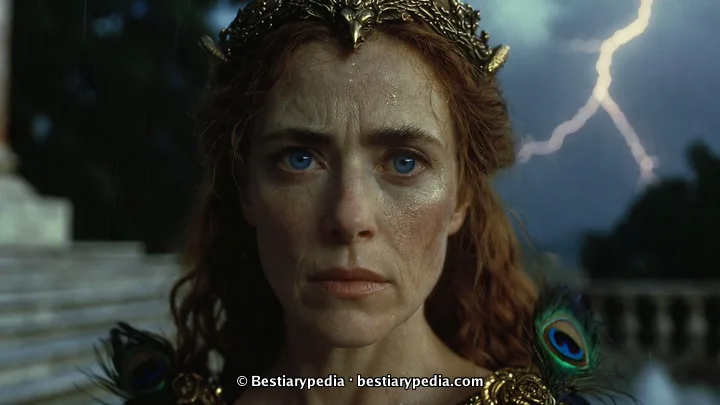
Juno
Juno, Roman goddess of marriage, the state and the protection of women