Zeus
Zeus, supreme god of Olympus and ruler of the sky, thunder and divine justice
Curated byBestiarypediaCreated onUpdated on
 Ancient Greece(Greece)
Family Tree








Mythical Origins of Zeus
Zeus was born to Cronus and Rhea as the youngest of the children of the first divine generation in Greek mythology. Warned by a prophecy that one of his children would dethrone him, Cronus devoured his offspring at birth. To save Zeus, Rhea hid him in a cave in Crete and gave Cronus a stone wrapped in swaddling clothes, which he swallowed in his place. There the child was nursed by the goat Amalthea and raised by nymphs, while the Curetes clashed their weapons to cover his cries. Upon reaching maturity, Zeus forced Cronus to regurgitate his brothers and sisters, freeing them from his interior, and thus began the rebellion against the Titans. This narrative appears detailed in ancient sources that describe his hidden childhood and the subsequent cosmic confrontation that established the Olympian order.
Titanomachy and Division of the Cosmos
Zeus led the ten-year war against the Titans, the Titanomachy, alongside his brothers Poseidon and Hades. To win, he freed from Tartarus the Cyclopes, who forged his thunderbolt, and the hundred-armed Hecatoncheires, who fought at his side. After victory he confined the Titans in Tartarus and divided the universe by lot, assigning the sky to himself, the sea to Poseidon and the underworld to Hades, thus establishing Olympian rule. This conflict symbolizes the triumph of the new order over the old and consolidates Zeus as supreme sovereign according to ancient epic accounts.
Attributes Powers and Legacy of Zeus
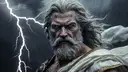
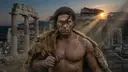
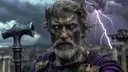
Zeus is depicted as a mature, muscular, bearded man holding the thunderbolt with which he controls storms, thunder and lightning; the eagle and the sacred oak accompany him. He can change shape to seduce mortals and goddesses, and he upholds cosmic order by punishing perjurers and protecting suppliants and guests. His cult dominated ancient Greece, with the great sanctuary of Olympia, seat of the Olympic Games held in his honor, and the oracle of Dodona. Identified with the Roman Jupiter, he influenced Western art, literature and philosophy as an eternal symbol of sovereign power and divine justice according to classical sources.
Also known as
Relics
🏺 Thunderbolt of Zeus
Supreme weapon forged by the Cyclopes, symbol of his thunder power.
🏺 Aegis
Invincible shield or mantle with Medusa's head, instilling terror.
Symbology
Element
Thunder
Number
Six
Color
Sky Blue
Animals
Eagle, Bull
Sigils:
🏷️ Traits
Powers
Weaknesses
Behavioral
Resistances
🔗 Relations with other beings
🗺️In the Atlas
Travel the beings’ world of origin and the cosmos of their dimensions.
📜 Mythologies
Greek mythology developed in Ancient Greece from the Late Bronze Age and reached its most elaborate form during the archaic and classical periods, between the 8th and 4th centuries BCE. It emerged among the Hellenic peoples who inhabited the Greek peninsula, the Aegean islands and the coasts of Asia Minor, and was transmitted mainly through the oral poetry of Homer and Hesiod, as well as local traditions collected in sanctuaries and festivals. Its worldview presents a universe ordered by a hierarchy of divinities that intervene in human and natural affairs, with Olympus as the dwelling of the principal gods and Hades as the destination of the deceased. The central deities include the twelve Olympians, headed by Zeus, god of the sky and sovereign, together with Hera, Poseidon, Athena, Apollo, Artemis, Aphrodite, Ares, Hephaestus, Hermes, Demeter and Dionysus. Before them, the Titans, among whom Cronus and Rhea stand out, ruled the cosmos until they were deposed by the Olympians in the Titanomachy. Other important entities are the Muses, the nymphs, the Cyclopes and the Moirai, who embody cosmic forces and destinies. This tradition exerted a lasting influence on the literature, art and thought of Rome, the European Renaissance and subsequent Western culture, supplying motifs, characters and narrative structures that have endured in philosophy, astronomy and the arts to the present day.
Sources
Theogony
Hesiod · -700
Poem by Hesiod detailing the origin of Greek gods and Titans.
Homer's Iliad
Homero · -750
Greek epic attributed to Homer (8th century BCE) about an episode of the Trojan War and the wrath of Achilles. With the constant intervention of the Olympian gods, it is one of the primary sources of the divinities and heroes of Greek mythology.
Library
Apollodorus · 100
Mythological compendium attributed to Apollodorus summarizing Greek legends.
Pausanias' Description of Greece
Pausanias · ca. 150 CE
Pausanias’ "Description of Greece" (2nd century), a geographical and religious guide to the Greek world. It tours sanctuaries, monuments and local cults, preserving myths, heroes and divinities that would otherwise have been lost.
Himnos Órficos a Zeus
null · null
Orphic hymn to Zeus (ancient Greece), from the collection of 87 liturgical Orphic hymns. It celebrates the king of the Olympian gods, lord of the thunderbolt and sovereign of the cosmos; in Orphic theology Zeus is proclaimed the beginning and end of all things.
Frequently asked questions
How was Zeus born and why did they have to hide him?
He is the youngest of the sons of the titans Cronos and Rea; Zeus is not a titan, but of the following generation, the of the olympians. Cronos devoured his children at birth so that none would dethrone him, so Rea gave birth to him secretly in Crete and delivered to her husband a stone wrapped in diapers. There the goat Amaltea nursed him and the nymphs raised him, while the Curetes clashed their shields to cover the crying. Already adult, he forced Cronos to vomit his brothers.
What role did Zeus play in the Titanomachy and how did he divide the cosmos after victory?
Zeus led the ten-year war against the Titans alongside Poseidon and Hades using the thunderbolt forged by the Cyclopes. After victory he divided the universe assigning the sky to himself, the sea to Poseidon and the underworld to Hades.
What physical attributes and characteristic powers are attributed to Zeus according to classical sources?
Zeus is depicted as a mature muscular man with a beard holding the thunderbolt that controls storms and thunder. He can change shape to seduce and upholds cosmic order punishing perjurers according to classical sources.
What symbols and animals are associated with Zeus in iconography and mythological symbology?
Zeus is associated with thunder, the eagle and the bull. His iconography includes the stylized thunderbolt with eagle and the aegis with Medusa's head that instills terror according to mythological sources.
🔖Cite this entry▾
If you cite this article in an academic, journalistic or editorial publication, use any of these formats:
Bestiarypedia. (2026, August 2). Zeus. Bestiarypedia. https://bestiarypedia.com/en/beings/zeus
Free citation with attribution and canonical link for editorial, academic or journalistic use. Full commercial reuse or creation of derivative products requires prior agreement.
Similar beings
Melinoe
Melinoe, chthonic goddess of specters and nightmares in the Orphic tradition
Hecate
Hecate, Greek goddess of magic, the moon, and crossroads
Ares
Ares, the Olympian Greek god of war, violence and martial ardor
Persephone
Persephone, goddess of rebirth, vegetation and queen of the underworld
Demeter
Demeter, Greek goddess of agriculture, grain and harvests
Hestia
Hestia, goddess of the home, sacred fire, and family in Greek mythology