Hecate
Hecate, Greek goddess of magic, the moon, and crossroads
Curated byBestiarypediaCreated onUpdated on
 Ancient Greece(Greece)
Mythical Origins of Hecate
Hecate is daughter of the titans Perses and Asteria according to Hesiod's Theogony, where she appears as a pre-Olympian goddess endowed with powers over earth, sea and sky. Her origin dates back to archaic traditions prior to the consolidation of the Olympian pantheon, making her a liminal figure associated with cosmic transitions and the protection of boundaries between worlds. In the Orphic Hymns she is invoked as a primordial goddess who grants prosperity and justice, highlighting her independence from Zeus and her role as mediator between the divine and the human. This titanic genealogy explains her dominion over crossroads and spirits, as she represents the crossing between mythological eras and the ability to guide souls through dark thresholds.
Powers, Attributes and Symbols of Hecate
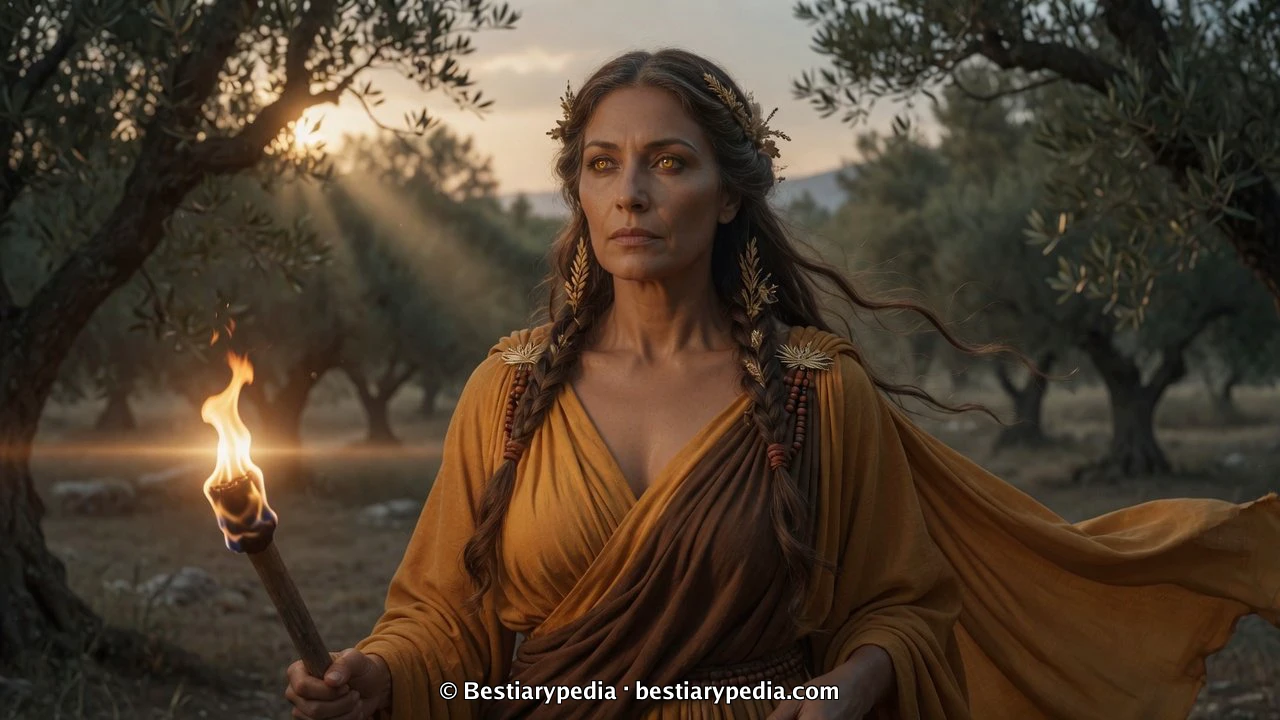
Hecate rules magic, necromancy, astrology and crossroads, carrying torches that light nocturnal paths and keys that open portals between realms. Her attributes include the triple form representing lunar phases and dominion over past, present and future; black dogs as guardians of thresholds; and the ability to grant prophetic visions or summon spirits. In Hellenistic and Roman tradition she is associated with the crescent moon and the protection of sorceresses, while in Agrippa's texts she is linked to planetary and angelic correspondences that expand her role in Renaissance occult philosophy. These symbols reinforce her function as guide of souls and protector of magical pacts in darkness.
Worship, Decline and Cultural Legacy of Hecate
The worship of Hecate was practiced at crossroads with food offerings and sacrificed dogs, spreading from archaic Greece to the Hellenistic and Roman world where she was syncretized with lunar and chthonic goddesses. With the spread of Christianity her worship declined, transforming into a symbol of black magic and demonic pacts in the Middle Ages, although it survived in European folklore as a protector of witches. In Renaissance occult philosophy, as detailed by Agrippa, Hecate regains relevance as an archetype of liminal wisdom and power over spirits. Her current legacy spans literature, neopaganism and popular culture, where she embodies female sovereignty over the occult and guidance in moments of personal or spiritual transition.
Also known as
Relics
🏺 Hecate's Torches
Pair of lit torches with which Hecate illuminates crossroads and guides between worlds.
Symbology
Element
Moon and Magic
Number
3
Color
Black
Animals
Dog and Serpent
Sigils:
🏷️ Traits
Powers
Weaknesses
Behavioral
Resistances
🔗 Relations with other beings
🗺️In the Atlas
Travel the beings’ world of origin and the cosmos of their dimensions.
📜 Mythologies
Greek mythology developed in Ancient Greece from the Late Bronze Age and reached its most elaborate form during the archaic and classical periods, between the 8th and 4th centuries BCE. It emerged among the Hellenic peoples who inhabited the Greek peninsula, the Aegean islands and the coasts of Asia Minor, and was transmitted mainly through the oral poetry of Homer and Hesiod, as well as local traditions collected in sanctuaries and festivals. Its worldview presents a universe ordered by a hierarchy of divinities that intervene in human and natural affairs, with Olympus as the dwelling of the principal gods and Hades as the destination of the deceased. The central deities include the twelve Olympians, headed by Zeus, god of the sky and sovereign, together with Hera, Poseidon, Athena, Apollo, Artemis, Aphrodite, Ares, Hephaestus, Hermes, Demeter and Dionysus. Before them, the Titans, among whom Cronus and Rhea stand out, ruled the cosmos until they were deposed by the Olympians in the Titanomachy. Other important entities are the Muses, the nymphs, the Cyclopes and the Moirai, who embody cosmic forces and destinies. This tradition exerted a lasting influence on the literature, art and thought of Rome, the European Renaissance and subsequent Western culture, supplying motifs, characters and narrative structures that have endured in philosophy, astronomy and the arts to the present day.
Sources
Orphic Hymns
Orpheus (attributed) · -300
Collection of ancient Greek hymns attributed to Orpheus invoking chthonic deities such as Melinoe.
Theogony
Hesiod · -700
Poem by Hesiod detailing the origin of Greek gods and Titans.
Three Books of Occult Philosophy
Heinrich Cornelius Agrippa · 1533
Renaissance encyclopedia of magic by Heinrich Cornelius Agrippa detailing planetary and angelic correspondences.
Frequently asked questions
Which ancient sources attribute Hecate's titanic genealogy and her independence from Zeus?
Hesiod's Theogony presents Hecate as daughter of the titans Perses and Asteria. The Orphic Hymns invoke her as a primordial goddess who grants prosperity and justice. These texts highlight her independence from Zeus and her mediating role between the divine and the human.
What attributes and symbols characterize Hecate's dominion over magic and crossroads?
Hecate rules magic, necromancy and astrology carrying torches and keys that open portals between realms. Her triple form represents lunar phases and dominion over past, present and future. Black dogs act as guardians of thresholds.
How was the worship of Hecate practiced and what transformations did her legacy undergo in later periods?
The worship of Hecate was practiced at crossroads with food offerings and sacrificed dogs. With the spread of Christianity her worship declined and became a symbol of black magic in the Middle Ages. In Renaissance occult philosophy she regained relevance as an archetype of liminal wisdom.
🔖Cite this entry▾
If you cite this article in an academic, journalistic or editorial publication, use any of these formats:
Bestiarypedia. (2026, August 3). Hecate. Bestiarypedia. https://bestiarypedia.com/en/beings/hecate
Free citation with attribution and canonical link for editorial, academic or journalistic use. Full commercial reuse or creation of derivative products requires prior agreement.
Similar beings
Melinoe
Melinoe, chthonic goddess of specters and nightmares in the Orphic tradition
Ares
Ares, the Olympian Greek god of war, violence and martial ardor
Persephone
Persephone, goddess of rebirth, vegetation and queen of the underworld
Demeter
Demeter, Greek goddess of agriculture, grain and harvests
Hestia
Hestia, goddess of the home, sacred fire, and family in Greek mythology
Artemis
Artemis, Greek goddess of the hunt, the moon and chastity