Umm al-Sibyan
Umm al-Sibyan, Arabic-Islamic female demon of infant mortality
Curated byBestiarypediaCreated onUpdated on
 Arabian Peninsula(Saudi Arabia)
⇄ Cultural variants (3)

4 beings in the lineage
Mythical Origins of Umm al-Sibyan
Umm al-Sibyan emerges in the traditions of Arabic-Islamic folklore as the female embodiment of the demon that causes miscarriages, deaths during childbirth, infant mortality, and seizures in nursing infants. Sources frequently identify her with the Qarinah, a companion spirit that accompanies humans from birth, and with Lilith, the ancestral figure of the child-killing lineage that appears in ancient regional tales. This identification forms the Arabic node of a broader archetype that spans multiple cultures, where the being acts as an agent of selective destruction against the most vulnerable. In accounts transmitted by al-Buni in Shams al-Maʿarif, her origin is described as linked to ancient pacts attributed to Solomon, who established seals to control similar entities. The oral tradition of the Arabian Peninsula and Egypt presents her as an earthly spirit that inhabits the boundaries between the visible and hidden worlds, activating in moments of human fragility such as pregnancy and delivery. Her cosmic role reflects the need for balance between life and loss, though always from the perspective of a threat requiring ritual intervention.
Manifestations and Powers of Umm al-Sibyan
Umm al-Sibyan exerts her influence primarily through the interruption of vital processes in the initial stages of human life. She causes spontaneous miscarriages, fatal complications in childbirth, and convulsions affecting nursing infants, interpreted in tradition as direct attacks by the spirit. These actions link to her identification with the Qarinah, which establishes an invisible bond with the mother or child, and with Lilith, whose mythological heritage emphasizes predation on newborns. Lane's accounts in Manners and Customs of the Modern Egyptians describe how the spirit manifests as shadows or subtle presences near the cradle, triggering sudden symptoms that only specific amulets can counteract. Her power concentrates in the earthly realm, without extending to celestial domains, and operates by exploiting moments of physical and spiritual vulnerability. Tradition emphasizes that these manifestations are not random but selective, targeting families lacking adequate ritual protection.
Ritual Protection and Amulets against Umm al-Sibyan
Tradition prescribes the use of specific amulets, the pacts of Solomon, and the protective suras known as muʿawwiḏatayn to conjure Umm al-Sibyan. These elements combine in practices that include placing seals on the cradle and reciting Quranic verses during pregnancy and childbirth. Doughty's accounts in his Arabian travels document how families employ these methods to create spiritual barriers that prevent the spirit's approach. The Seal of Solomon appears as a central symbol that reinforces ritual authority over demonic entities. The efficacy of these protections depends on the correct execution of the rites and continuity in their application, according to al-Buni's sources. This ritual approach reflects a worldview where human intervention can modify the course of hidden forces that threaten the continuity of life.
Relics
🏺 Seal of Solomon
Seal of Solomon inscribed on amulets to protect newborns from umm al-sibyan, a demoness who attacks them.
Symbology
Element
Spirit
Number
7
Color
Black
Animals
Black cat
Sigils:
🏷️ Traits
Powers
Weaknesses
Behavioral
Resistances
🗺️In the Atlas
Travel the beings’ world of origin and the cosmos of their dimensions.
📜 Mythologies
Arabian folklore encompasses oral traditions, tales from One Thousand and One Nights, and supernatural beings like djinn, ifrit and marid, spirits created from smokeless fire according to the Quran (Surah 55:15), originating in pre-Islamic myths of the Arabian Peninsula, reflecting Bedouin animism, fears of desert spirits, sandstorms and oases, compiled in medieval literature like the works of Al-Jahiz and transmitted in regions like Hijaz, Yemen and the Maghreb.
Sources
Shams al-Maʿarif
al-Buni · 13th century
Work attributed to al-Buni on magic and protective seals in medieval Islamic tradition.
Manners and Customs of the Modern Egyptians
Edward William Lane · 1836
Ethnographic study by Edward William Lane on 19th-century Egyptian customs, including references to popular beliefs.
Travels in Arabia Deserta
Charles Montagu Doughty · 1888
Travel account by Charles Montagu Doughty through Arabia with observations on local traditions and protective beliefs.
Frequently asked questions
How is Umm al-Sibyan identified with the Qarinah and Lilith in tradition?
Tradition presents her as the Arabic node of the child-killing archetype, linking her directly to the Qarinah through the invisible bond and to Lilith through the lineage of infant predation.
What ritual elements are used to conjure Umm al-Sibyan?
Amulets, the pacts of Solomon, and the muʿawwiḏatayn suras are used, combined with seals on the cradle and Quranic recitations during pregnancy and childbirth.
What symbols reinforce ritual authority over Umm al-Sibyan?
The Seal of Solomon and amulets placed on the cradle act as central emblems that channel protection derived from ancient pacts and Quranic suras.
🔖Cite this entry▾
If you cite this article in an academic, journalistic or editorial publication, use any of these formats:
Bestiarypedia. (2026, August 3). Umm al-Sibyan. Bestiarypedia. https://bestiarypedia.com/en/beings/umm-al-sibyan
Free citation with attribution and canonical link for editorial, academic or journalistic use. Full commercial reuse or creation of derivative products requires prior agreement.
Similar beings
Shiqq
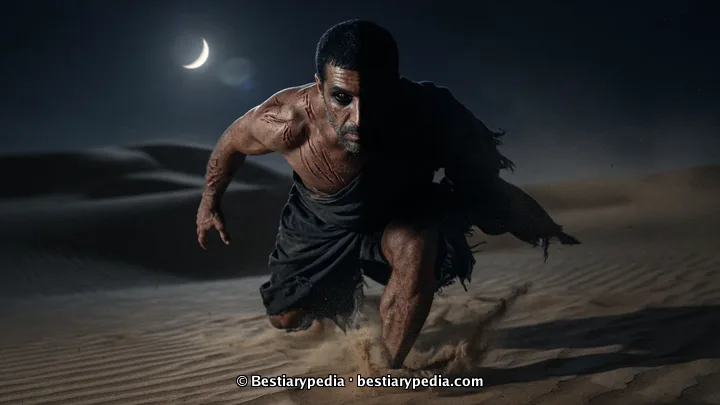
Shiqq, pre-Islamic Arab demon of half-body that stalks desert paths
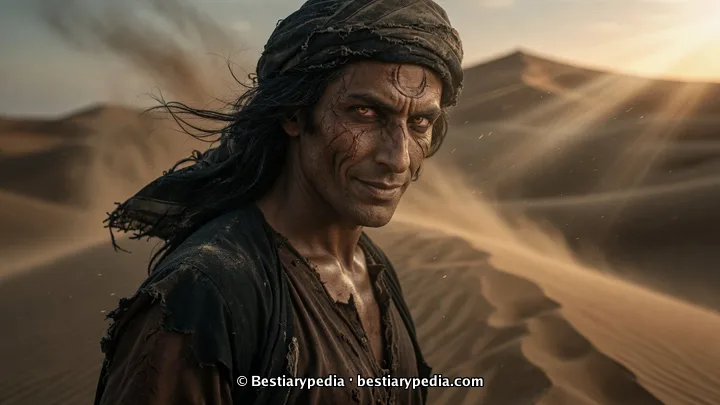
Ghaddār
Yemeni jinn who tortures desert travelers
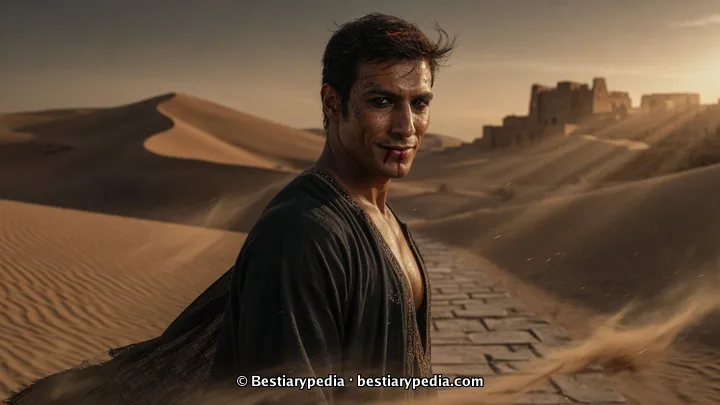
Qarīn
Qarīn, male spirit-double who whispers temptations according to Islamic tradition
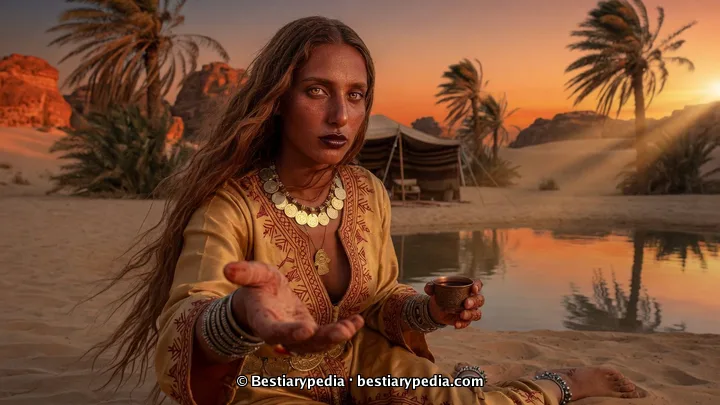
Si'lat
Si'lat Desert Seductress
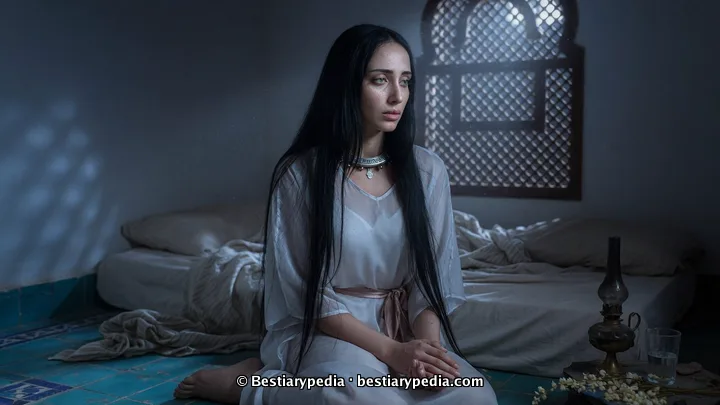
Qarinah
Qarinah, soul companion linked to the human man in pre-Islamic Arabian folklore