Shiqq
Shiqq, pre-Islamic Arab demon of half-body that stalks desert paths
Curated byBestiarypediaCreated onUpdated on
 Arabian Peninsula(Saudi Arabia)
Origins of the Shiqq in pre-Islamic Arab mythology
The shiqq emerges in the oral traditions of the Arabian Peninsula before the arrival of Islam as a desert spirit linked to lonely paths and nocturnal dangers. The medieval compilations of al-Qazwini in Aja'ib al-Makhluqat collect accounts transmitted by Bedouins that describe this being as born from the sands themselves when the wind blows in opposite directions. Al-Masʿudi in Muruj al-Dhahab mentions similar entities among the jinn of southern Arabia that attack travelers to block passage to sacred oases. Al-Jahiz in Kitab al-Hayawan documents observations by shepherds who attribute to the shiqq the ability to divide from the human body during possession rituals. These sources agree in placing its appearance in the jahiliyyah period when tribes worshiped local spirits before religious unification. The shiqq shares lineage with other demons of the same cycle such as the ghūl and the ghaddār forming a triad of desert route stalkers. Its existence explains the origin of the nasnas since the union of a shiqq with a human woman produces that one-legged one-eyed creature according to the chain of transmission collected by the same authors.
Split appearance and powers of the Shiqq
The shiqq manifests as the longitudinal half of a human body with a single eye a single arm and a single leg that moves by hopping on the remaining limb. This incomplete form allows it to hide behind dunes or rocks and surprise walkers on desert paths. According to al-Qazwini the being possesses disproportionate strength despite its half body and can knock down an adult man with a single blow. Al-Masʿudi adds that the shiqq emits a shrill whistle that disorients victims before the attack and that its single eye shines in the dark like a wandering star. Al-Jahiz records that the demon can temporarily merge with a traveler's shadow to steal his vital breath. These abilities make it a feared adversary for caravans crossing the peninsula at night. The split duality symbolizes the fracture between the visible and invisible worlds proper to pre-Islamic cosmology.
Relation of the Shiqq with the Nasnas and other spirits
The tradition collected by al-Qazwini al-Masʿudi and al-Jahiz establishes that the nasnas is born directly from the union between a shiqq and a human being. This offspring inherits the half body of the demonic father resulting in a creature with one leg and one eye that inhabits the same deserts. The shiqq acts as the generative counterpart of the nasnas completing a cycle of reproduction between the world of the jinn and the human. It also shares territory with the ghūl that devours corpses and with the ghaddār that deceives walkers with illusions. The three entities form a brotherhood of stalkers that punish those who travel without ritual protection in the pre-Islamic Arabian Peninsula. This kinship network explains the persistence of accounts of nocturnal encounters on ancient trade routes and underscores the symbolic function of the split duality as a warning against transgression of sacred boundaries.
Relics
🏺 Stone of the opposing wind
Amulet stone that, in Arabian folklore, protects against the shiqq, a half-bodied demon that waylays travelers on the roads.
Symbology
Element
Sand
Number
1
Color
Ochre
Animals
Scorpion
Sigils:
🏷️ Traits
Powers
Weaknesses
Behavioral
Resistances
🔗 Relations with other beings
Ally of
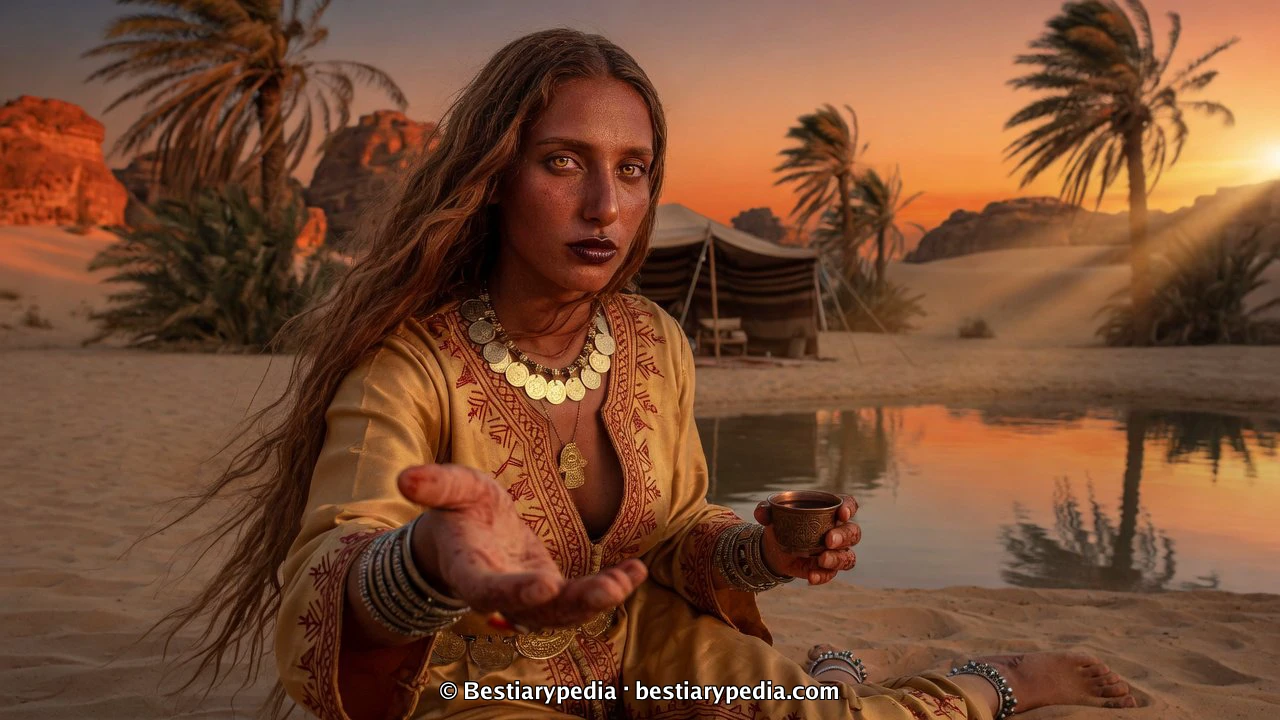
🗺️In the Atlas
Travel the beings’ world of origin and the cosmos of their dimensions.
📜 Mythologies
Arabian folklore encompasses oral traditions, tales from One Thousand and One Nights, and supernatural beings like djinn, ifrit and marid, spirits created from smokeless fire according to the Quran (Surah 55:15), originating in pre-Islamic myths of the Arabian Peninsula, reflecting Bedouin animism, fears of desert spirits, sandstorms and oases, compiled in medieval literature like the works of Al-Jahiz and transmitted in regions like Hijaz, Yemen and the Maghreb.
Sources
Meadows of Gold
al-Masʿudi · 947
Tenth-century historical and geographical work by al-Masʿudi describing peoples and supernatural beings of Arabia and neighboring regions.
ʿAjāʾib al-Makhlūqāt (Wonders of Creation)
Zakariyyāʾ al-Qazwīnī · c. 1263
13th-century Arabic cosmography by al-Qazwīnī describing the wonders of creation: stars, geography, animals, jinn and marvelous beings.
Kitāb al-Ḥayawān (Book of Animals)
Al-Jāḥiẓ (Abū ʿUthmān ʿAmr ibn Baḥr al-Kinānī) · c. 776-868
Arabic zoological and literary encyclopedia by the scholar al-Jāḥiẓ (9th century), gathering real animals and fabulous creatures with anecdotes and theology.
Frequently asked questions
How is the nasnas born according to the tradition transmitted by al-Qazwini?
The nasnas is born from the union between a shiqq and a human being. This offspring inherits the half body of the demonic father.
What does the split form of the shiqq symbolize in pre-Islamic cosmology?
The split duality symbolizes the fracture between the visible and invisible worlds and warns against transgression of sacred boundaries.
With which other demons does the shiqq share territory according to al-Masʿudi?
It shares territory with the ghūl that devours corpses and the ghaddār that deceives walkers with illusions forming a brotherhood of stalkers.
🔖Cite this entry▾
If you cite this article in an academic, journalistic or editorial publication, use any of these formats:
Bestiarypedia. (2026, August 3). Shiqq. Bestiarypedia. https://bestiarypedia.com/en/beings/shiqq
Free citation with attribution and canonical link for editorial, academic or journalistic use. Full commercial reuse or creation of derivative products requires prior agreement.
Similar beings
Ghaddār
Yemeni jinn who tortures desert travelers
Umm al-Sibyan
Umm al-Sibyan, Arabic-Islamic female demon of infant mortality
Qarīn
Qarīn, male spirit-double who whispers temptations according to Islamic tradition
Si'lat
Si'lat Desert Seductress

Qarinah
Qarinah, soul companion linked to the human man in pre-Islamic Arabian folklore