Quetzalcóatl
Feathered Serpent
Curated byBestiarypediaCreated onUpdated on
 Central Mexico(Mexico)
Origins of Quetzalcoatl
Quetzalcoatl, known as the Feathered Serpent, emerges in Mesoamerican cosmogonies as a primordial deity associated with wind, wisdom, knowledge, and creation. In Aztec mythology, he is considered one of the creators of the current world, participating in the act of sacrifice to shape the fifth sun. According to the myth, Quetzalcoatl and his brother Tezcatlipoca opposed each other in the creation and destruction of previous worlds. In the fourth era, Tezcatlipoca overthrew Quetzalcoatl, plunging the world into darkness until the latter, with the help of the other gods, sacrificed himself to create the sun. In other Toltec traditions, Quetzalcoatl is the civilizing god who taught humans the art of agriculture, metallurgy, and writing. His origin dates back to ancient texts like the Maya Popol Vuh, where he appears as Gukumatz, and in earlier Olmec inscriptions that suggest a pan-Mesoamerican cult.
Appearance and Symbolism
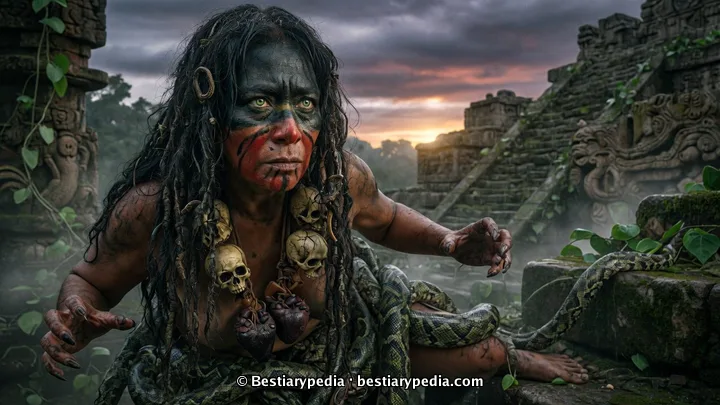
Quetzalcoatl is depicted as a gigantic serpent covered in green and turquoise feathers, symbolizing the fusion of sky and earth, the terrestrial and the celestial. Its scaly body evokes primordial waters and wind, while the quetzal feathers, sacred bird of Guatemala, represent lightness and divinity. In sculptures like that of Teotihuacan, it appears as a serpent with a jaguar head or beard, fusing attributes of other gods. In Aztec codices like the Codex Borgia, it is shown with a conch in hand, alluding to its role as lord of life and fertility. Other forms include Ehecatl-Quetzalcoatl, wind god with conical mask and blowpipe to blow winds, or as Toltec priest-king Topiltzin, human with divine attributes. This dual symbolism of feathered serpent embodies Mesoamerican cosmic duality: life-death, sky-earth.
Cult and Divine Relations
The cult of Quetzalcoatl flourished in Teotihuacan, Tula, and Cholula, with dedicated temples like the Cholula Pyramid, the largest in the world. The Toltecs venerated him as Topiltzin Quetzalcoatl, a historic king deified who promised to return from the east. The Aztecs honored him with human sacrifices and offerings of jade, feathers, and cacao, associating him with the planet Venus as Tlahuizcalpantecuhtli, the dawn star. In divine relations, he rivals Tezcatlipoca, dark mirror of his light, in cycles of creation-destruction; allies with Xipe Totec in renewal and with Tlaloc in fertility. In Maya myths, as Kukulcan in Chichen Itza, he descends as a civilizing prophet. His legacy influenced the Spanish conquest, as Aztecs mistook Cortes for his prophesied return, facilitating the fall of Tenochtitlan.
Also known as
Relics
🏺 Cholula Pyramid
Great pyramid of Cholula, the largest monument consecrated to Quetzalcoatl, the feathered serpent.
Symbology
Element
Air
Number
1
Color
Green
Animals
Quetzal, Serpent
Sigils:
🏷️ Traits
Powers
Weaknesses
Behavioral
Resistances
🗺️In the Atlas
Travel the beings’ world of origin and the cosmos of their dimensions.
📜 Mythologies
Mesoamerican mythology encompasses the religious and cosmological traditions of the pre-Hispanic civilizations of Mesoamerica, including Olmecs, Zapotecs, Mixtecs, Mayas, Toltecs, and Aztecs. It stands out for its complex cosmogonies with cyclic eras of creation and destruction, primordial deities like Quetzalcoatl the Feathered Serpent and Tezcatlipoca, human sacrifice rituals to nourish the sun and the earth, sacred calendars like the tonalpohualli and the haab, and great ceremonial centers like Teotihuacán, Monte Albán, Palenque, Chichén Itzá, and Tenochtitlán. It reflects an animist, dualistic, and polytheistic worldview, influenced by trade, maize agriculture, and flowery wars.
Sources
Florentine Codex
Sahagún, Bernardino de · 1577
Illustrated encyclopedia of Nahua culture compiled by Friar Bernardino de Sahagún around 1577, in Nahuatl and Spanish. It describes in detail the Aztec deities—Quetzalcoatl, Tezcatlipoca, Tlaloc—and numerous beings of the Mesoamerican world.
Codex Borgia
Anonymous · c. 1500
Mesoamerican pictographic manuscript of ritual and divinatory content, predating the Spanish conquest. Filled with images of gods such as Quetzalcoatl, Tezcatlipoca and Mictlantecuhtli, it is a fundamental source of the religion and pantheon of central Mexico.
Frequently asked questions
How did Quetzalcóatl participate in the creation of the fifth sun according to Aztec traditions?
Quetzalcoatl is considered one of the creators of the current world. He participated in the act of sacrifice to shape the fifth sun. In the fourth era, after being overthrown by Tezcatlipoca, he sacrificed himself with the help of other gods to create the sun.
What characteristic attributes distinguish Quetzalcoatl's appearance in Mesoamerican representations?
He is depicted as a gigantic serpent covered in green and turquoise feathers. Its scaly body evokes primordial waters and wind. The quetzal feathers symbolize lightness and divinity, fusing attributes of other gods in sculptures such as those of Teotihuacan.
What relationship did Quetzalcoatl maintain with Tezcatlipoca in the cycles of creation and destruction?
Quetzalcoatl and Tezcatlipoca opposed each other in the creation and destruction of previous worlds. In the fourth era, Tezcatlipoca overthrew Quetzalcoatl, plunging the world into darkness. Quetzalcoatl rivals him as the dark mirror of his light in cycles of creation-destruction.
What role did Quetzalcoatl play as a civilizing god in Toltec traditions?
In Toltec traditions, Quetzalcoatl is the civilizing god who taught humans the art of agriculture, metallurgy, and writing. The Toltecs venerated him as Topiltzin Quetzalcoatl, a historic king deified who promised to return from the east.
🔖Cite this entry▾
If you cite this article in an academic, journalistic or editorial publication, use any of these formats:
Bestiarypedia. (2026, August 3). Quetzalcóatl. Bestiarypedia. https://bestiarypedia.com/en/beings/quetzalcoatl
Free citation with attribution and canonical link for editorial, academic or journalistic use. Full commercial reuse or creation of derivative products requires prior agreement.