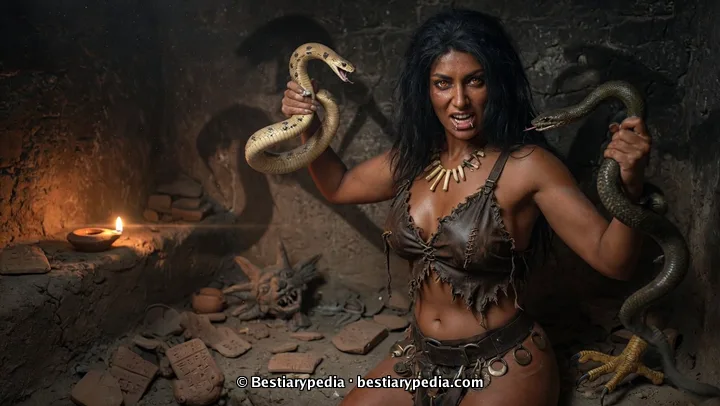
Ardat Lili
Ardat Lili, lili maiden and virginal specter of the Mesopotamian demonic triad
Curated byBestiarypediaCreated onUpdated on
 Mesopotamia(Iraq)
⇄ Cultural variants (2)

3 beings in the lineage
Origins and Nature of Ardat Lili
Ardat Lili forms the third figure of the Mesopotamian demonic triad integrated by lilû, lilitu and ardat lilî. Her Akkadian name means approximately the lili maiden or the girl of the wind. The incantations present her as the young woman who died a virgin without having married or known a man, so she wanders restlessly seeking the absent bridal bed. The exorcism texts describe her as the one who has no husband, who has not given birth and who does not know how to raise children. This condition makes her the exact counterpart of the fulfilled woman in Mesopotamian society, embodying everything that can go wrong in a female life. Her figure shares with Lilitu the demonic class, the method of attack and the textual destiny that later feeds the subsequent Hebrew Lilith.
Activities and Methods of Attack
Ardat Lili lies with sleeping men to beget from them spectral children who do not belong to the world of the living. She especially pursues brides and newlyweds, threatening the continuity of the family and legitimate fertility. The incantations of the Maqlû series invoke her together with other demons of the nocturnal wind to neutralize her influence over the conjugal bed. Her symbology revolves around the nocturnal wind, the torn bridal veil and the empty bed that represents the frustration of every matrimonial destiny. This behavior distinguishes her within the triad as the one most directly oriented to interrupt female rites of passage and the ordered reproduction of ancient Mesopotamian society.
Relations and Textual Legacy
Ardat Lili maintains ties of kinship and cultural variant with Lilitu and with Lilith. Both demonesses share the same class, the same method of nocturnal seduction and the same textual destiny that converges in the figure of Lilith as it appears in biblical and medieval texts. The Epic of Gilgamesh mentions wind demonic entities that are related to this triad. The Akkadian incantations of the Maqlû series constitute the primary source documenting her existence and her functions within the Mesopotamian demonic pantheon. Her legacy persists as an archetype of the frustrated maiden who threatens the matrimonial and reproductive order, influencing later traditions of the ancient Near East.
Relics
🏺 Maqlû Tablet
Tablet of the Babylonian Maqlû ritual, whose incantations drive off the ardat-lili and other night demons.
Symbology
Element
Wind
Number
1
Color
Black
Animals
Owl
Sigils:
🏷️ Traits
Powers
Weaknesses
Behavioral
Resistances
🗺️In the Atlas
Travel the beings’ world of origin and the cosmos of their dimensions.
📜 Mythologies
Mesopotamian mythology developed in the region situated between the Tigris and Euphrates rivers, in the territory that today corresponds to Iraq and bordering areas, and spans an extensive period that begins with Sumerian civilization around the fourth millennium BCE and continues through the Akkadian, Babylonian and Assyrian cultures until the Hellenistic era. Its tales were transmitted on clay tablets written in Sumerian and Akkadian, and reflect a worldview in which the gods controlled the forces of nature and human destiny, while kings acted as intermediaries between the divine world and society.
Sources
Utukku Lemnutu series (incantations against evil demons)
Babylonian scribes · c. 700 BCE
Mesopotamian series of Sumerian and Akkadian incantations against the utukku lemnutu, the evil demons that assail humankind.
Epic of Gilgamesh
Sin-leqi-unninni (editor) · c. 2100–1200 BCE
The great Mesopotamian epic (2nd millennium BCE), preserved on cuneiform tablets. It recounts the deeds of King Gilgamesh and Enkidu, his quest for immortality and a primeval flood, and is an essential source of Sumerian and Babylonian gods and demons.
Maqlû Series
Ancient Babylonian scribes · c. 700 BCE
The Maqlû series is a collection of ancient Babylonian incantations (c. 700 BCE) against demons like Lilitu, preserved on clay tablets, detailing her attacks on sleepers and pregnant women.
Frequently asked questions
How does Ardat Lili fit into the Mesopotamian demonic triad?
Ardat Lili constitutes the third figure of the triad alongside lilû and lilitu. She represents the maiden who died a virgin and who pursues the absent bridal bed.
What actions does Ardat Lili perform against sleeping men and newlyweds?
She lies with sleeping men to beget spectral children and pursues brides and newlyweds, threatening legitimate fertility.
What relationship does Ardat Lili maintain with Lilitu and Lilith?
She shares with Lilitu the demonic class, the method of attack and the textual destiny that converges in the later Hebrew Lilith.
🔖Cite this entry▾
If you cite this article in an academic, journalistic or editorial publication, use any of these formats:
Bestiarypedia. (2026, August 3). Ardat Lili. Bestiarypedia. https://bestiarypedia.com/en/beings/ardat-lili
Free citation with attribution and canonical link for editorial, academic or journalistic use. Full commercial reuse or creation of derivative products requires prior agreement.