Medusa
Medusa, the petrifying gorgon with snakes for hair in Greek mythology
Curated byBestiarypediaCreated onUpdated on
 Ancient Greece(Greece)
Mythical Origins of Medusa
Medusa, one of the three gorgons in Greek mythology, emerges in archaic traditions as daughter of Phorcys and Ceto, primordial deities of the sea and the monstrous. Hesiod in his Theogony describes her as the youngest of the immortal gorgons Stheno and Euryale, distinguishing her by her unique mortality, making her vulnerable to heroic fate. Her origin roots in the pre-Olympian chaos, where Phorcys represents deep and dangerous waters, and Ceto marine voracity, begetting hybrid creatures like the Graeae, Echidna and the dragon Ladon. This marine genealogy emphasizes abyssal terror, positioning the gorgons as fierce guardians of the forbidden. Later variants, such as in Apollodorus' Library, confirm this parentage, adding that they dwelt at the far west, near the Hyperborean realm, a liminal place between the known world and the supernatural. Her birth is not narrated in detail, but a natural emanation of the chthonic pantheon, symbolizing the petrifying power as a metaphor for paralysis before the unknown.
Appearance and Powers of Medusa
Medusa is iconized with a hideous female head, hair turned into living hissing serpents symbolizing venom and primordial chaos. Her eyes emit a lethal petrifying ray, turning mortals into stone statues upon direct gaze, a power shared with her sisters but amplified in her by narrative variants. Golden bird-of-prey wings allow erratic flight, protruding fangs and protrusile tongue evoke marine predators, while scaly skin and curved claws reinforce her hybrid ferocity. Ovid in the Metamorphoses offers an etiological version: originally a beautiful priestess of Athena raped by Poseidon in her temple, punished with this monstrous form, turning beauty into abomination. This mortal-monstrous duality underscores themes of divine vengeance and ritual pollution. In archaic art, like on the shield of Athena Parthenos statue, she appears with beard and archaic Greek smile, evolving in the classical period to a more feminine and terrifying figure, always with writhing serpents and hypnotic eyes.
Myth of Perseus and Medusa's Legacy
The central myth of Medusa revolves around Perseus, son of Zeus and Danaë, who receives from Athena and Hermes the task to behead her as a gift for Polydectes. Guided by the Naiads, he obtains winged sandals, horse jaw, reflective shield, and Hades' helmet for invisibility. In the western cave, he avoids her gaze using the shield as a mirror, severs her head with a harpe, and from her neck spring Pegasus and Chrysaor. The petrifying head, given to Athena, adorns her aegis as an apotropaic weapon against foes. Post-mortem, her blood generates coral in the Sahara and lethal poisons, per tales. This heroic cycle transforms Medusa from invincible monster to civilizing trophy, symbolizing rational triumph over chaotic instincts. In cultural legacy, her image endures in shields, Roman mosaics, and Renaissance art, representing fascinating horror; Freudian psychoanalysis interprets her as maternal castration, while modern feminism reclaims her victimization by gods.
Also known as
Relics
🏺 Head of Medusa
Severed snake-haired head that petrifies whoever looks upon it, even after Medusa's death.
🏺 Gorgon Blood
Medusa's blood: that from the left side kills, that from the right can raise the dead.
Symbology
Element
Stone
Number
3
Color
Green
Animals
Serpent, Pegasus Horse
Sigils:
🏷️ Traits
Powers
Weaknesses
Behavioral
Resistances
🔗 Relations with other beings
🗺️In the Atlas
Travel the beings’ world of origin and the cosmos of their dimensions.
📜 Mythologies
Greek mythology developed in Ancient Greece from the Late Bronze Age and reached its most elaborate form during the archaic and classical periods, between the 8th and 4th centuries BCE. It emerged among the Hellenic peoples who inhabited the Greek peninsula, the Aegean islands and the coasts of Asia Minor, and was transmitted mainly through the oral poetry of Homer and Hesiod, as well as local traditions collected in sanctuaries and festivals. Its worldview presents a universe ordered by a hierarchy of divinities that intervene in human and natural affairs, with Olympus as the dwelling of the principal gods and Hades as the destination of the deceased. The central deities include the twelve Olympians, headed by Zeus, god of the sky and sovereign, together with Hera, Poseidon, Athena, Apollo, Artemis, Aphrodite, Ares, Hephaestus, Hermes, Demeter and Dionysus. Before them, the Titans, among whom Cronus and Rhea stand out, ruled the cosmos until they were deposed by the Olympians in the Titanomachy. Other important entities are the Muses, the nymphs, the Cyclopes and the Moirai, who embody cosmic forces and destinies. This tradition exerted a lasting influence on the literature, art and thought of Rome, the European Renaissance and subsequent Western culture, supplying motifs, characters and narrative structures that have endured in philosophy, astronomy and the arts to the present day.
Sources
Theogony
Hesiod · -700
Poem by Hesiod detailing the origin of Greek gods and Titans.
Library
Apollodorus · 100
Mythological compendium attributed to Apollodorus summarizing Greek legends.
Metamorphoses
Ovid · 8
Work by Ovid narrating mythological transformations including marine interventions.
Pausanias' Description of Greece
Pausanias · ca. 150 CE
Pausanias’ "Description of Greece" (2nd century), a geographical and religious guide to the Greek world. It tours sanctuaries, monuments and local cults, preserving myths, heroes and divinities that would otherwise have been lost.
Frequently asked questions
From which primordial deities does Medusa descend according to archaic traditions?
Medusa emerges as daughter of Phorcys and Ceto, primordial deities of the sea and the monstrous. Hesiod presents her as the youngest of the immortal gorgons Stheno and Euryale. Her origin roots in the pre-Olympian chaos.
What physical attributes and powers characterize Medusa in mythical descriptions?
Medusa is depicted with a hideous head, hair turned into living serpents and eyes emitting a petrifying ray. She possesses golden wings, fangs and claws that reinforce her hybrid ferocity. Ovid adds the version of her transformation by Athena.
What relationship does Medusa maintain with the hero Perseus in the central myth?
Perseus receives from Athena and Hermes the task to behead Medusa as a gift for Polydectes. Guided by the Naiads, he uses a reflective shield to avoid her gaze and severs her with a harpe. From her neck spring Pegasus and Chrysaor.
What symbolic function does Medusa's head acquire after her decapitation?
The petrifying head is given to Athena and adorns her aegis as an apotropaic weapon against foes. Post-mortem, her blood generates coral in the Sahara and lethal poisons. It represents rational triumph over chaotic instincts.
🔖Cite this entry▾
If you cite this article in an academic, journalistic or editorial publication, use any of these formats:
Bestiarypedia. (2026, August 3). Medusa. Bestiarypedia. https://bestiarypedia.com/en/beings/medusa
Free citation with attribution and canonical link for editorial, academic or journalistic use. Full commercial reuse or creation of derivative products requires prior agreement.
Similar beings
Lamia
Lamia, the seductive mythological Greek serpent devourer of children
Mormo
Mormo, spectre of Hecate's retinue and Greek bogey
Eurynomos
Eurynomos, chthonic daemon corpse-devourer of the Greek Hades
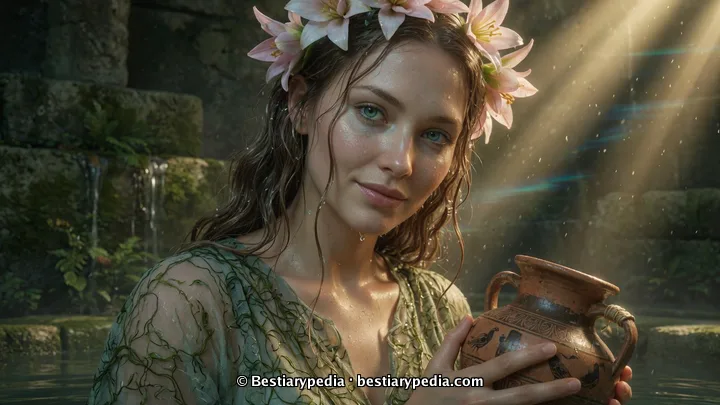
Naiads
Naiads, water nymphs guardians of rivers, springs, and fountains in Greek mythology
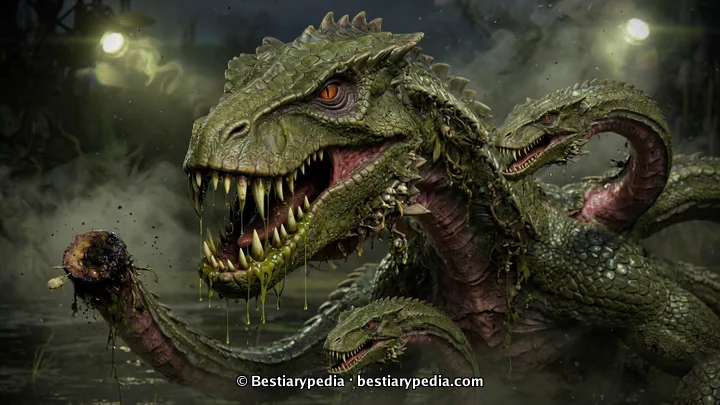
Lernaean Hydra
Lernaean Hydra, the multi-headed water serpent that regenerates in Greek mythology
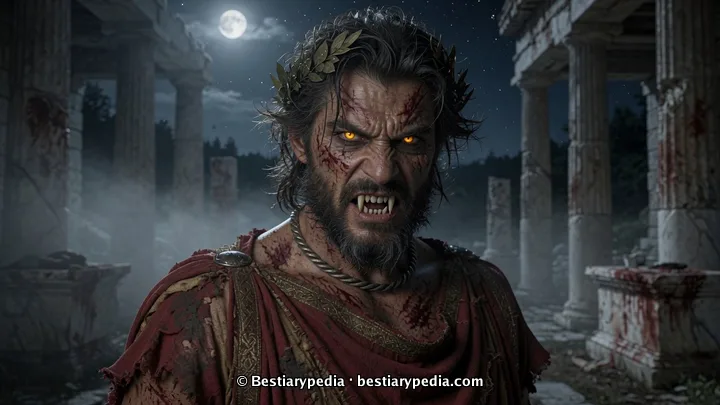
Lycaon
Lycaon, Arcadian king turned into a wolf by Zeus